
While navigating my way through our walk of Derby I decided to find a new way of viewing Derby or a new aspect I’d never seen before. For a city it’s very compact, the city centre and all the shops are very clustered with little walks in between all the facilities you’d expect in a city.
The roads in Derby centre themselves are interesting in the fact that a large majority are one way, with some exception of only taxis or busses being allowed accessed in both directions. This gave me an idea for my walk, the fact that cars in a city centre for the most part are required to follow a one-way route; Yet while on foot you’re free to walk where you want and in any direction. However, has this one-way route concept positioned itself in our mind a one-way view point? It came to my realisation that people follow their own routes on auto pilot, they tunnel vision their walks and keep to the same routines as it’s just natural and the walkability of a city is made so simplistic. What came to my mind was, does anyone ever look up? We stick to our regular routes and even most commonly stick to the same side of the road every journey we make presenting us the same repetitive view.

Have cities become a product to gentrification and lost all identity or are people becoming more ignorant to look up and around? People stay in their technological worlds that’s available right at their fingertips so there is no thought process to change routine. People’s loss is there ability to take everything for face value, no one looks for a new perspective because it’s all the same in a city and their phones can supply 24/7 entertainment and aesthetics that are constantly changing. Shop fronts become generic, gentrification brings shop fronts in town centres to look the same and all present a commercialised presence that we’ve all seen before.
Phil Smith talks about experiencing walks for more than a walk, he believes walking is like acting and your surroundings become a partner in the performance. He suggests we should look beyond the literal; our feelings are ambiguous as an imagist poetry so you should interpret accordingly. Smith refers to the concept of varying the height of your head from the ground or even lying down to witness the perspective of a rough sleeper. He also makes mention in his work “carry a light plinth for looking over walls. In shopping areas check out the storeys above the generic ground floor shop fronts”. An understanding of what a city really has to offer, when you look for a new perspective and became very present to me.
Looking up in any city presents you with an entirely new city, as I found walking through Derby. The ironic thing is it presents an entirely new city which in actual fact it presents you with the old city, the history of Derby and all found new character to the buildings around you. I found the old Post Office building entirely due to looking up, if I didn’t, I’d still be under the impression that the building was just an over priced club I’d been into once in my life.
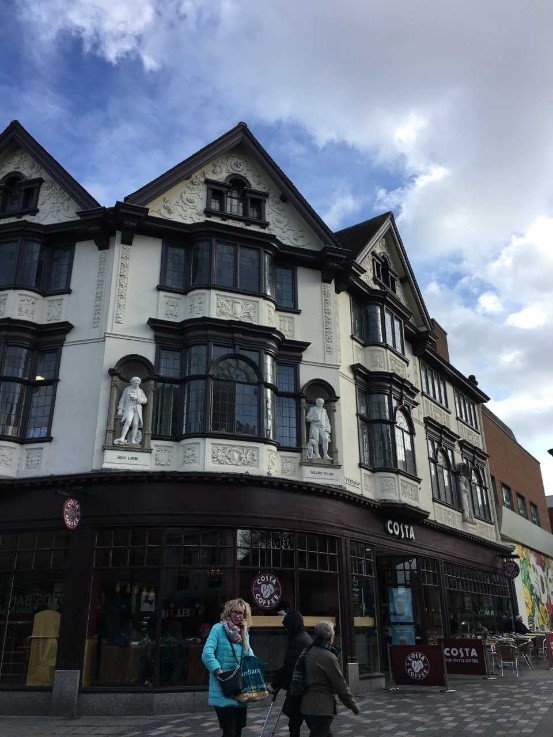
Above shop fronts you could see real definition in designs, like old style architecture houses displayed above generic, dull shop fronts. More surprises unfolded the further I walked into the centre, I found myself at a Costa coffee, a shop you’re never to far away from in any town or city. What surprised me was above the one placed in Derby City centre displays statues of historic Derby figures like, John Lombe and William Hutton each being from or having an impact upon Derby’s industrial history.
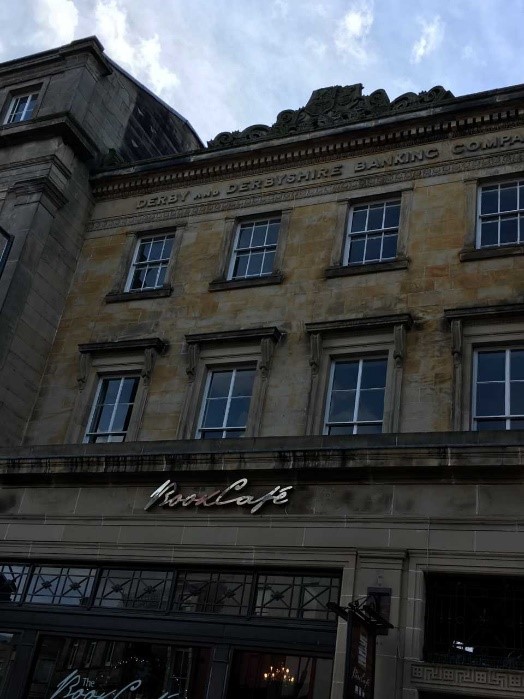
I once again found myself amazed and coincidentally it was due to another café, above The Book Café in Derby another piece of history left untouched by time which was where once the Derby and Derbyshire’s Banking Company stood. A building once so important and essential in the running of the county becoming a simple café with everyone oblivious to the fact of the building’s original role in the history of Derby. To uncover this and learn something new all that is needed from people is to look up and out of their tunnel vision lives.
While walking along people even looked at me funny for looking up and taking photos of the tops of buildings. It was clearly weird for locals to see someone looking at the top of a building in Derby and especially to the extent of taking photos. This only confirmed to me even more that people don’t look up and around, they stick to there routes of the city and never see anything new. My concept became even more apparent when a fellow student, who had lived in Derby all his life said from just looking up even he saw and learnt new things; Just from seeing through a new perspective and observing the second floor of his city.
Our cities are made to be structured horizontally, it’s seen as what’s best for a city layout and is why everyone orientates around the ground floor levels and pays little interest or thought to look any higher. Le Corbusier imagined a vertical concentration of urban population, rather than horizontal. I wondered as I walked along, if our cities were based more around Le Corbusier’s concept of a vertical city would people still not take note of what’s above face value?
 Derby Urban Sociology