
Having provided the class who were embarking on this walk with a number of ideas on how to walk with the intention of seeing another city, of taking a new approach to the familiar, of renewing space I found myself without a clear idea of the scripts my own walk was going to draw on for inspiration. I trusted in serendipity and spontaneity. They didn’t disappoint.
As I set off, a woman passed and was talking about fairy lights into her phone and this began to frame a number of encounters that would suggest my theme. I started taking photos of buildings and objects that might contribute to a story of this part of Derby. Next to our University building is a newly built block of student residences. I watched them being built over wasteland that, during the building process was stripped of a layer of resurgent green to reveal the cobbles and tracks of old railway lines. These included the ones featured at the start of this film:
We currently teach and learn roughly on the site of the Friargate Station. Fairies and the hidden past. I felt like I was onto something. Quickly, one after the other, an angel, and then a haunted house.

I’m going to be talking about the new religious movement, Heaven’s Gate on the day after our walk and I’m very conscious of Christopher Partridge’s observation (https://www.tandfonline.com/doi/abs/10.1016/j.religion.2004.04.014) that in their beliefs,
Western demonological ideas are conspicuous here. Space aliens are fallen technological angels seeking to tempt humans away from the truth.
Angels, a distraction from… well, there’s another blog post in that but then, almost immediately I saw the entrance to Derby Gaol.
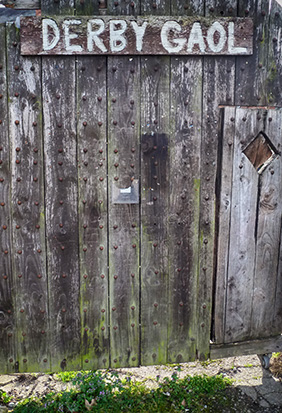
This is run by local popular historian Richard Felix and its tales are to some degree interwoven with tales of the supernatural. No doubt this stems from his participation in the television programme Most Haunted. Here I thought of Mikel Koven’s article ‘Most Haunted and the Convergence of Traditional Belief and Popular Television’. In this he suggests that Most Haunted is typical of a very particular convergence of cultural forms. In its case, folkloric ghost legends and populist television programmes. He draws on the use of the term ostentation as it is used in folklore studies,
‘This is where individuals, after hearing certain stories, decide to engage in legend-like activities themselves,’ (Koven 2008, 184).
It was becoming obvious, I should look for the folkloric, the legendary and the mythical. I’d already talked to students about Phil Smith’s mythogeography so this had the happy effect that happenstance had presented something that would be familiar to students. More particularly, it suggested what I was doing, searching for legends; seeking to confirm – or uncover – the hidden surfaces of local landscapes. (If, at any point, you wonder what I am going on about here – tying together fiction, folklore, academia, instinct, and more – then visiting his site is strongly advised.)
I passed an abandoned tax office. The underground car park reminded me of 1970s Dr Who. A misdirected scientist, perhaps in thrall to The Master, conducting an experiment that would see a malevolent alien in the guise of a figure from folklore return to bring terror once more. Or, in the hands of the less subtle 1980s and the modern reboot, a more direct evocation of (the banality of) evil, The Bureaucrats.

Another clue (a demonic-angelic misdirection?) seemed to be this drain cover. I tried, and failed, to find symmetry in its pattern of wholes. I still do. In the the upper half is symmetry is evident but it’s elusive in the lower half.
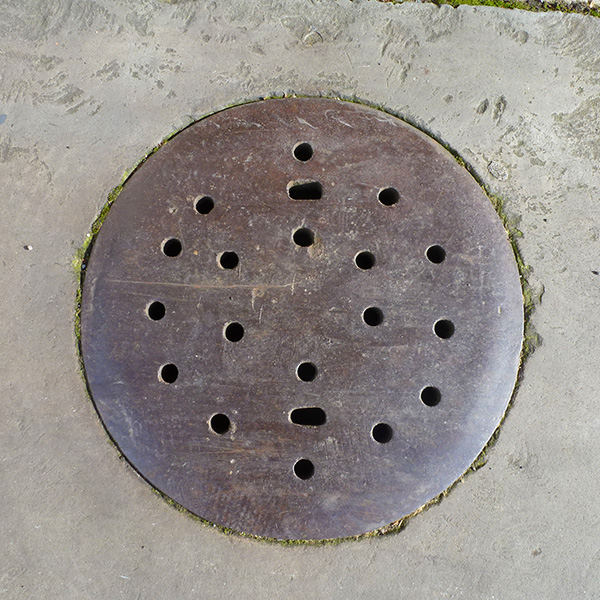
I was hoping that this walk would offer a route away from my usual academic concerns: the resurgence of fascism and the far right and their use of current cultures of conspiracy and apocalyptic thought. But in this drain cover, I could sense those particular shadows once again. I tried to distract myself and thought of Charles Rangeley-Wilson’s account of getting down on his hands and knees to listen at a drain cover for the lost river Fleet under the street of central London in The Accidental Angler. I tried it. I heard nothing, an absence of sound. The refusal of symmetry instead made me think of the cosmic horrors of H.P. Lovecraft, unfolding themselves through impossible angles, ‘non-Euclidean geometries’, which brought me back to this portal. It looks like it should have symmetry but refuses it. But I didn’t want to enter a Lovecraftian world of unfathomable terror in the face of the cults and beliefs of the seaborne Other. Apparently, the current Labour leader, Jeremy Corbyn, has a love of manhole covers; and, yes, I know I shouldn’t have but I thought of accounts of Lovecraft’s anti-Semitism and the very public reckoning with its evils that the Labour party are currently undergoing. I moved on, away from the unsettling cover.
On the corner of the street leading to my destination, the long abandoned Great Northern Railway Goods Warehouse where I’d arranged to meet back up with the students, serendipity redirected me once more. On someone’s bin there was a box of unwanted items. I took a couple of saucers and a couple of books: Jamaica Inn and a novelisation of an old BBC radio serial, Waggoner’s Walk.
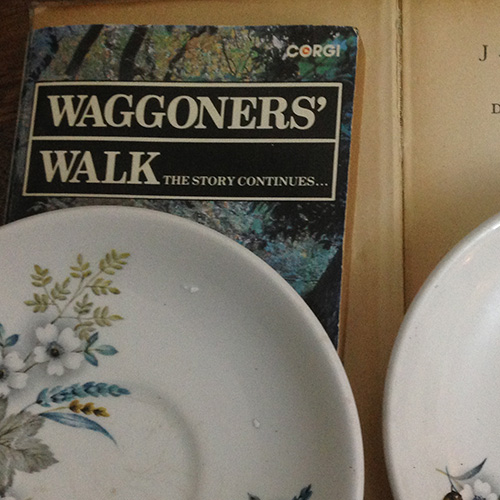
The generous householder lived at the corner opening on to a cul-de-sac. Waggoner’s Walk was set, yes, on a cul-de-sac. Happy at this coincidence I felt that the walk’s narrative was emerging once more. The title nagged at me for a while. There was something more to it, I felt.
I climbed the steps to the abandoned Warehouse, set on a large patch of open ground; wasteland in all fairness. Since getting home from the walk it dawned me how suggestive it is of the Parthenon when viewed from the roundabout where Uttoxeter New Road meets Stafford Street. The warehouse and its gardens provide a shortcut to the City Centre from the mostly residential areas clustered around Uttoxeter Old Street. Its spaces also provide temporary refuge for sections of the city’s population of substance users, and a multiple canvasses for graffiti artists. We met a trio of final year undergraduate urban planning students from the University of Sheffield. It’s fitting that they were there. The Warehouse and the surrounding spaces are good examples of the Future Voids that Rob Roggema described,
Future voids are defined here as ‘any empty space in an urban system, that can enable local agents to respond to adverse events (disasters, disorder) or promising opportunities (new technologies) at any time in the future’ (Roggema 2018, 353)
Part of the surroundings are a large area of concrete and plans exist to build a school there. But what of the people who currently use it? The ‘void’ is still a place for them; none were there whilst I walked around but they had left behind signs, signifiers and material reminders of their lives random detritus among the beer cans, fire sites and the paraphernalia of dependencies: burnt spoons and sharps.
The first thing that struck me were the lines of sight that connected the location to the University’s One Friar Gate Square, ‘the copper building’, our starting point. Below, the platforms on either side of the railway line that once led towards it can be seen; they would have crossed the railway bridge that still spans Friar Gate; itself now walled and fenced off. Also the subject of ‘plans’ – a railway carriage restaurant. Derby continually turns to its past to seek to reinvent itself. This is the reimaging of a city as a spur to planned gentrification that Deborah Stevenson describes in The City,
What is being sold in city reimaging and promotion strategies is not simply the physical (often redeveloped) spaces of the city, but also its symbolic spaces, including how the city feels, what it means and what it looks like (Stevenson 2013, location 0426)
This is the aim of, ‘Marketing Derby [which] promotes Derby and Derbyshire in order to attract and support investment.’ They’ve made a promotional video (‘Imagine a City’) and it opens with a view of the copper building and then speaks of Derby’s industrial past and the history of innovation associated with the city and its environs. Exploring the abandoned shell of that history, I found other phantasms besides those of Jebediah Strutt, Richard Arkwright, Joseph Wright, Charles Rolls and Henry Royce.
The past is always with us in human spaces; from field patterns to street names and the archeosemiotics of building forms. It can be celebrated in plaques, it can be a shameful burden in the form of memorials to colonial nightmares (within sight of the Warehouse is Curzon Street – named after the Viceroy of India during the famine of 1899-1900); it can also become buried under new layers of meaning and the rhythms and patterns of fresh usage. But it is always there.
The rail lines that directed vision across to the copper building mark a linear passage from the abandoned past to the inhabited present; from a railway heritage to an expanding university quarter. I realised it was these lines of connection that could be drawn onto the city that offered me the connective tissue of meaning that drew my walk together. The Waggoner’s Walk book was a clearer clue than I’d realised. The title was strongly suggestive of Alfred Watkins’ The Old Straight Track, the classic mythopoetic study that gave rise to the idea of ley lines – Billy Mills gave a good account in The Guardian. Among Watkins’ claims is the idea that these lines of ancient power were trade routes – flows of capital designed by wise folk, sensitive to the landscape and beguiling to those without their sight; prehistoric counterparts to the phantasmagoric shopfronts that lured Benjamin back to the city again and again and the phantasmagoria influenced by Benjamin‘s channelling. Mills refers to John Michell’s new age enchantment of Watkins’ idea in his 1969 work, The View Over Atlantis. In this the leylines become conduits of intense magical power, radiating spiritual power through and within Britain’s ancient sites.
Again, my day job swerves into view at this point and warns me of ideas associated with sacralized landscapes and how these are redolent with ideas of national destinies and purity. Amy Hale has written about these themes in relation to John Michell’s politics and the evolving appropriation and use of his ideas. She warns us,
In addition to the more Pagan friendly topics within Michell’s corpus such as the emphasis on small, rural, decentered polities, crafts, anti-capitalism, and conservation, Michell also embraced traditional hierarchical and gender divisions and elitist theocracies. All of these positions of are consonant with anarcho-fascism or anarcho-monarchism, which are two potential political frameworks supported by New Right philosophy. (Hale 2011, 95)
But, whilst enchanted lands and the notion of ‘their people’ are available for appopriation by nationalists and especially the far right, there is a value in recalling the uses of looseknit intensifications of beliefs and spiritual practices that happen in ad hoc gatherings of people. Marion Bowman uses the powerful idea of ‘vernacular religion’ to describe religion as it is understood and used ‘on the ground’ and it seems particularly appropriate here because the Warehouse is enmeshed in symbolic forms that speak of religious practices.
Bearing echoes of the phallus of the Cerne Abbas giant, the Warehouse has a white paint phallus pointing outward. K.T. in Notes and Queries of September 13, 1930 provides accounts of the giant that describe it as being used as a site of fertility rituals in living memory. In this century, it is described by the ‘Slimbridge Dowsers’ as being part of a ley line connecting it to (where else?) Stonehenge. The Warehouse phallus has its own lines of sight. It points along Mercian Way – named after the ancient kingdom – toward the spire of Christ Church, now secularised on Normanton Road. The Mercian Way becomes Lara Croft Way.
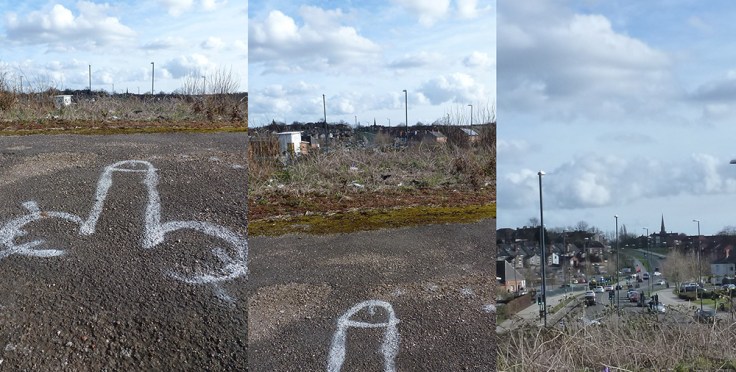
In addition to the railway line linking the Warehouse to the copper building a further line, ancient and modern, Mercia and Lara Croft. On another walk I might look for other lines radiating outward from the Warehouse, like the radial lines of vision spreading out from l’Arc de Triomphe.
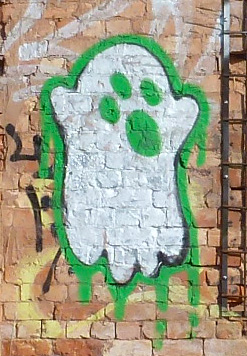
This is very much my own layer of vernacular religion but the surfaces of the Warehouse are marked with the vernacular religious speech of its visitors. Recalling the angel at the start of the walk, a UFO landing is painted on the wall, shrines to dead celebrities promising their return mingle with one of the slogans of arch conspiracy theorist David Icke.
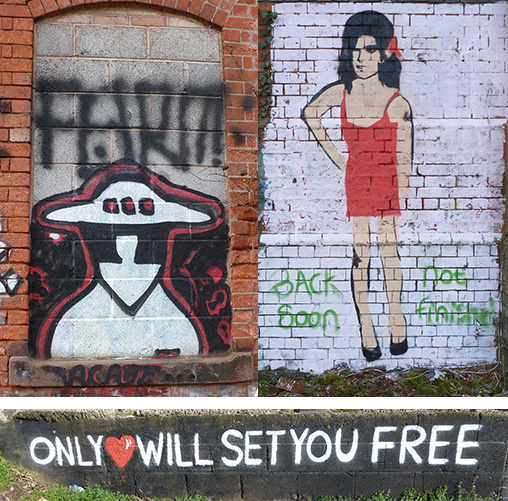
UFOs, conspirituality? The Warehouse had led me back to familiar ground once again; I’ve also written about the dreamed of return of iconic national celebrities. I felt that this solipsism was another trap, another misdirection. I hadn’t come here to find my own work and the intellectual obsessions that drive me but for the city to reveal itself to me; or, at least, for one of the versions of Derby that I hadn’t yet experienced to show itself. I pressed on.
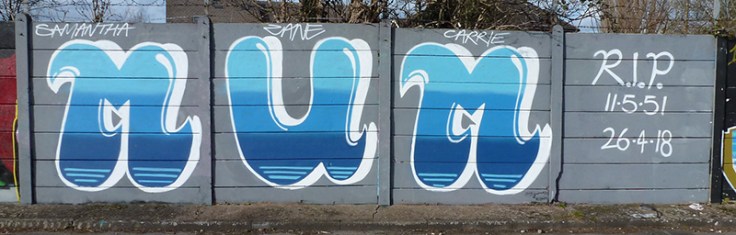
I’ve mentioned the concrete space that is currently due to become a school. With one or two missing sections it is entirely enclosed by a concrete wall; the wall is 7-8 feet high and it stretches round a perimeter of roughly half a mile. Every inch of the surface is painted on. Some figurative work but mostly huge blocky tags or abstract patterns. Between the tags are occasional memorial spaces, the one below being simply to ‘Mum’.
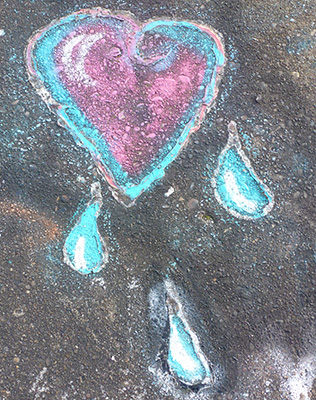
On concrete plinths other makeshift commemorative works are painted; here a personal message, there a blue-edged bleeding heart shedding blue-edged tears.
As the cost of dying continues to rise this multipurpose space provides an opportunity to record lives passing, to remember and to grieve. Amy Winehouse, sacralised national darling, substance user, chanteuse of the demi-monde promises a return, ‘Back soon…not finished’. Amidst the memorials she offers hope of the life eternal; hope amidst the chaos, a vernacular Mary Christ.
The void space is filled with meanings. On this walk I’ve been drawn to the vernacular religious interactions with space; more suggested themselves – a grove with a shamanic space; a bed of needles for a smack swami; concealed, illuminated interior worlds; pathways into the unknown; and an icon of a postmodern Anubis: technicolour pug doggo. Credo!
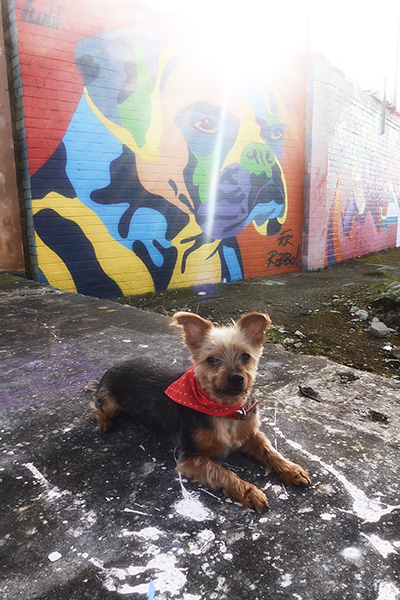
I should make clear I’m not seeking to romanticise nor diminish the everyday challenges faced by the people who congregate round the Warehouse. They are not homogeneous and should not be thought of as such. Certainly, the substance users whose addictions leave material reminders all around the site have lives blighted by austerity and a lack of public will to address their convergent and interrelated needs. But whilst their substance use patterns their social networks and the stigma that they – and the places associated with them – experience it does not negate what they share with all of us. Instead, what I hope to suggest is that amidst lives and lifestyles that are depicted as problematic or, indeed, a threat to public order there are strands of meaning that are shared across the fields of the social.
It may be that this feels like a somewhat weighty place to end a walk in which the city I saw was pieced together from shreds of contingent meaning that I encountered along the way but it was this narrowing down of my vision – this happenstance hyperopia – that allowed some of the meanings apparent in this place to become apparent. It permitted me to see afresh some of the culture that allows this space, blighted by territorial stigmatization, to unburden it and its users of their shared stigma. This is part of the culture of the city, no more and no less than that of the creative class so desired by the planners and managers of postindustrial cities reimaging themselves. The temporary residents and visitors to the postindustrial wastelands of modern cities are always already engaged in the process of reimaging and remaking the spaces around them, making them theirs: places of meaning derived from the organic, the vernacular and resistant to the imposed structures of ordered renewal. A final reminder, borrowed from Phil Smith, ‘Our enemies are not each other. But the homogensation, policing and reduction of multiplicity.’

 Derby Urban Sociology
Leave a comment